

Several weeks ago, someone on Twitter asked people to name a book they know they should have read but are ashamed to admit they haven’t. Answers ranged from To Kill a Mockingbird, Jane Eyre, and A Tale of Two Cities (I salute this last person) to whole genres in general. Russian literature got a huge shoutout as a major gap for many people.

I am often plagued with nightmares. They are vivid, violent, and visceral.
The other night, I dreamed that I was in a public plaza full of people: Some were milling around, some were protesting, and some were rioting. It was chaotic and loud. I was trying to leave with a group of people, and something made me turn around and head back. When I did, a man with a gun came after me. I grabbed a chair and held it up between us, but he knocked me to the ground, put his gun to my neck, pulled the trigger, and then walked away.

Once upon a time, there was a princess who was so beautiful that even the sun, who saw everything, was bemused by her beauty every time he shone down upon her.

Dear parents who suddenly have their schooled children at home,
A Quiet Place has become one of my family’s favorite movies over the past few years. Anytime we have a house guest, my children’s first question to them is, “Have you seen A Quiet Place?” If the answer is no, that guest had better be prepared to get their pants scared off because my children will force them to watch it.
What can I say? My children are homeschooled and therefore unsocialized—not much I can do.

A couple of months ago, one of my logic students told me that she didn’t need to take my class to be successful. It’s a tough class with a highly specific vocabulary and skill set, and they have it at the end of the school day, which hurts their brains. She said that her father never took logic in high school, and he is successful, so she doesn’t need to take logic to be successful, either.
I was overjoyed by the statement. Now we could have some real fun. I responded, “Do you think I teach you logic in order for you to be successful?”

No one questions the whole idea of homeschooling more than a homeschool mom in February. February is a notoriously hard month for homeschool moms. It’s the month most of us want to throw in the towel, quit, hide under a pile of fun books, and send our children to boarding school. In Switzerland.

My daughter, Mary Judah, has very strong opinions about paintings by Georgia O’Keeffe. MJ cannot stand O’Keeffe’s work.
We did the audio tour for the O’Keeffe special exhibit at San Francisco’s De Young Museum years ago. One of the stations on the tour included a recording of O’Keeffe herself talking about art and what makes good art. She said something along the lines of how good art has fewer and fewer details and distractions.

“The campus of Justin may be a haven from the war, a haven from reality, but when reality is so grim, to be a haven may be a virtuous thing. Soon, only too soon, reality will burst the walls and swell the gutters of the school to boiling livid streams, but the interim is ours and is not the interim as real as reality?” —Louis Auchincloss
A common critique lobbed at homeschoolers is this: Homeschooling shelters children from the “real world” too much. I shouldn’t have googled this concept. That’s a rabbit hole I wish I hadn’t gone down.

Last year, I spent the Sunday night after Thanksgiving in the ER.
My husband, Joshua, had been battling persistent pneumonia for months and had finally been cleared right before the holiday weekend. That Sunday, a mere ten minutes before friends arrived for a Thanksgiving leftovers dinner, Joshua started not feeling well. He became nauseated, had trouble breathing, and started having violent chills and a fever.

Proverbs 26:4 says, “Answer not a fool according to his folly, lest thou also be like unto him.” The very next verse says, “Answer a fool according to his folly, lest he be wise in his own conceit.”
The whiplash while reading wisdom literature like this often leaves one wondering what she ought to do. Do I answer the fool, or don’t I? The answer, of course, is this: It all depends. Sometimes, both happen at the same time.
In Ovid’s Metamorphoses, we get some good samples of folly.

Now that we’ve been back at school for several weeks, there is a certain type of Facebook post that has become commonplace amongst my friends whose children go to school: the drop-off and pick-up line angst post.
This should really be a Facebook post genre in its own right, up there with posts about politics, extreme weather, and arguments about obeying the gods.

There is no anxiety quite like homeschool mom anxiety. Can I get an amen?

It is pivotal that we read the right stories to our children when they are young so they will learn three things. The first is to never get involved in a land war in Asia. The second is to never go in against a Sicilian when death is on the line. And the third is to never—never—accept and eat any food that is offered to you by a witch.

“ . . . [W]e continue to clamour for those very qualities we are rendering impossible. You can hardly open a periodical without coming across the statement that what our civilization needs is more ‘drive,’ or dynamism, or self-sacrifice, or ‘creativity.’ In a sort of ghastly simplicity we remove the organ and demand the function. We make men without chests and expect of them virtue and enterprise. We laugh at honor and are shocked to find traitors in our midst. We castrate and bid the geldings be fruitful.”
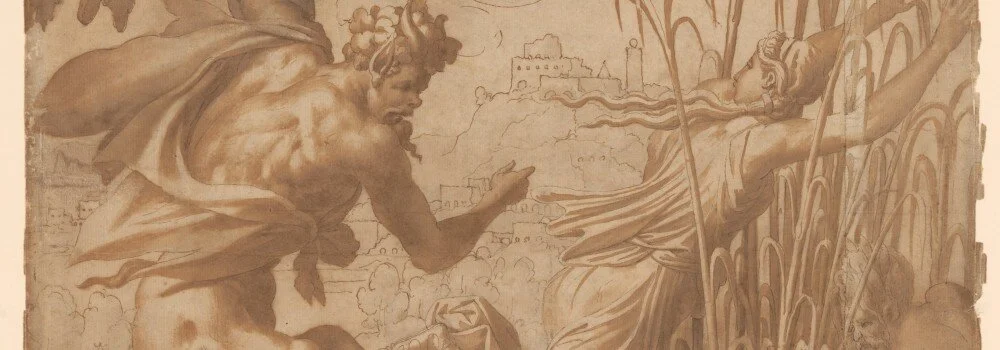
I am reading Ovid’s Metamorphoses all the way through, beginning to end, for the first time this summer. I have read bits and pieces, and I have looked up certain stories or references in order to become familiar with them, but I’ve never read the whole thing. Being the extrovert that I am, I didn’t want to read it alone, so I started a Facebook group for the sole purpose of roping friends and strangers into reading it along with me.

That’s it, people. It is summer. Finally. We are done with the school year!
Facebook is full of last day of school pics and videos of kids jumping into the pool for the first time this season. Grills have had the spring pollen dusted off and are being put to perpetual use. Burgers, chlorine, cut grass, and sunscreen are now the scents of summertime. There are parties and graduation ceremonies, and countless homeschool moms have collapsed onto the floor, saying, “We did it.”

We are a remembered people, it makes us who we are. Though sometimes I’d like to forget.

I feel a little bit like cheating writing this after reading Ian’s recent post on The Bronze Bow, but I, too, had an interesting discussion in my literature classes recently while trying to decide on where to place the climax of a story.

I’m currently in the middle of a unit in some of my literature classes where we are reading and discussing fairy tales. Reading and talking about fairy tales is quite possibly my very favorite thing to do ever. I might be only a tiny little bit hyperbolic about that. Just a smidge. I could honestly do nothing but teach fairy tales all year, every year, and be perfectly happy.

Three years ago, I left a church community that had become spiritually abusive.
(There. I said it. Whew.)

There’s no wrath quite like the wrath of a two-year-old child who wants nothing to do with you.

“Can I have a carnation?” I asked. The look of confusion on the lady’s face was absolutely priceless. It amused me.

A friend asked me last week what I’ve learned from Lent this year. I didn’t really have an answer at the time, but I’ve been giving this some thought. What I’ve learned is that, as it turns out, I really suck at Lent.

You know what pisses me off about Wendell Berry? It's that he's always right.

If you haven’t argued with Andrew Kern over an ancient epic, then I’m sorry to say you haven’t lived.

Today was our first day of school, and I was woefully unprepared.


We spent the June session of the Pelican Society’s Office Hours pondering teaching with Socratic discussion. Socratic discussion and teaching is relatively new to me, I’m embarrassed to admit. This probably isn’t as true as I believe, for at its most basic level, Socratic teaching is asking questions, and doesn’t everyone ask questions all the time?
There are not many things that instill terror in me more right now than the thought that I could be a careless or unskilled teacher to my students. Full disclosure: I teach my own kids; I’m a homeschool mom. I know.

Growing up in Houston, after-church Sunday dinner was a hard and fast ritual for my family.